Imaginative Play | vector poem
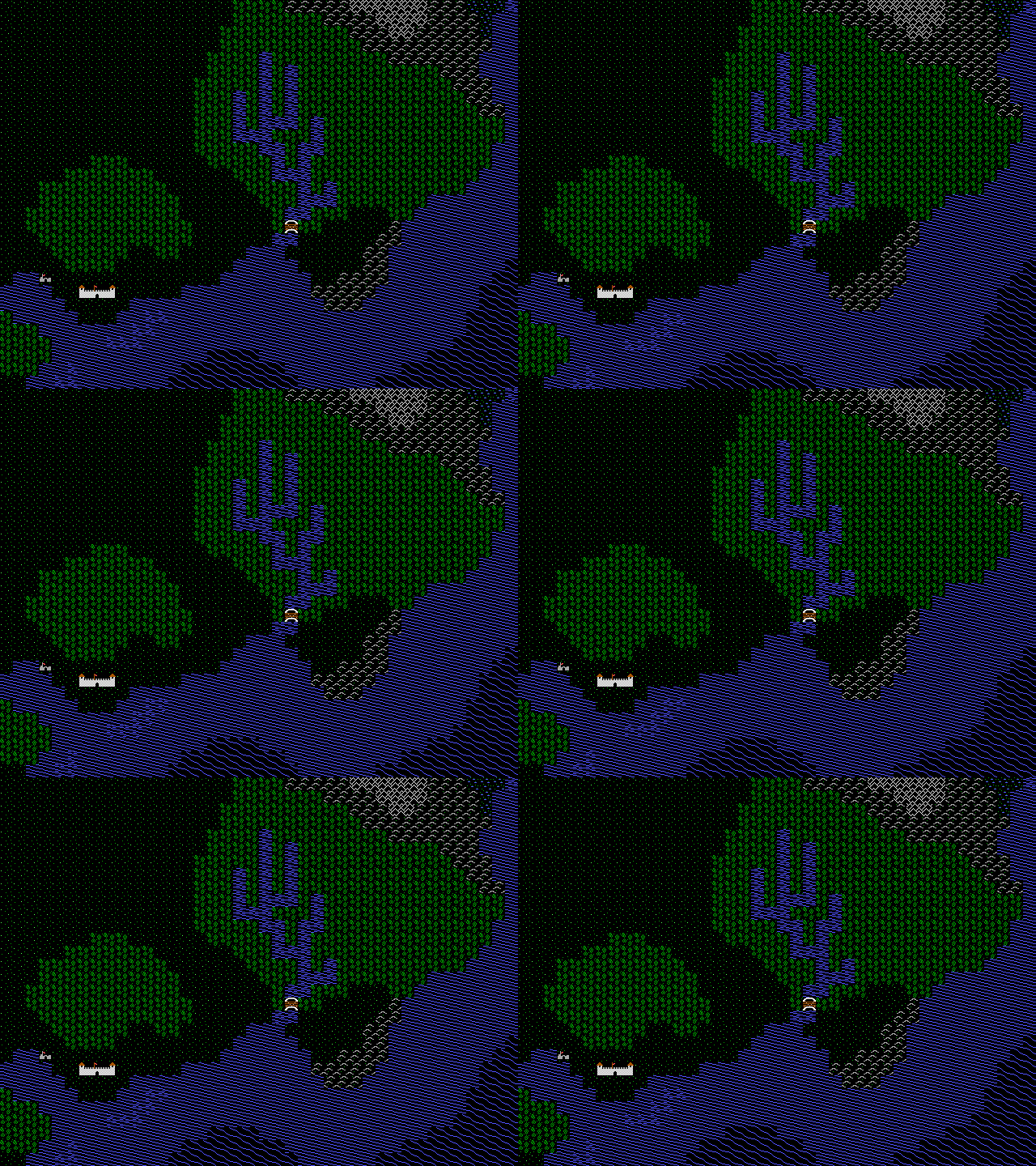
Do you remember this place?
[1]
This isn’t a standard “old fogey remembers classic game fondly” post though. Ultima IV’s tremendous influence and importance aside, I think for players looking back on it from today, it now exemplifies a value that is quite rare in most modern games: encouragement of the player to engage by using their imagination.
What does this mean though? What does a game that fosters “imaginative engagement” look, sound and play like in 2009?
I feel this question is worth asking simply because the sort of engagement we might give players by embracing this lost art could be powerful, richly subjective and, in a word, personal. Your mental image of a game’s world or a character’s voice might be different from mine [2]. You invite the game into your own mind, to an extent, rather than being enveloped entirely by the imagination of the author. In a word, you participate in a way that complements the actual interactivity.
The dominance of literal images in our culture notwithstanding, this value is actually far from alien to art/entertainment media: just remember what happens every time you read a book. You have to call every person, place and event into being in your mind. The experience depends entirely upon your engagement and interpretation – your brain is the minimum system requirement.
In fact, this value isn’t even alien to games of the electronic kind. Interactive fiction is an established medium whose potential is reasonably well-explored, and whose overlap with written fiction is obvious. Further down the continuum towards conventional videogames, we have games with primitive, but more importantly stylized or symbolic graphics. The best of these still have an effect closer to that of a well-written novel than a film – they evoke images and ideas that are quite grand compared to the simple stuff of which they’re made.
Low Fidelity
In the bad old days, hardware was so limited that games couldn’t muster much for audiovisual feedback. Creators had no choice but to stylize and abstract – to communicate as best they could within the limited fidelity of their format.
It’s also true that compared to today, fewer games tried to create a sense of a fiction or world. Games like Tetris still hold up today largely on the strength of their rules, their integrity as formal systems, and for such games the clarity and aesthetic attractiveness of these abstractions were all that mattered.
Early computer role playing games had quite a different lineage, extending most directly from pen and paper RPGs like Dungeons and Dragons. Games like Temple of Apshai, which augmented its modest 8-bit graphics with a manual full of written descriptions of each room in its dungeons, are the missing link between D&D and later RPGs like Ultima IV onward.
Even with more arcadey games, it’s clear that box art of the era played a big part in providing a starting point for imaginative engagement – check out all the crazy stuff on the cover painting of Missile Command for the Atari 2600:
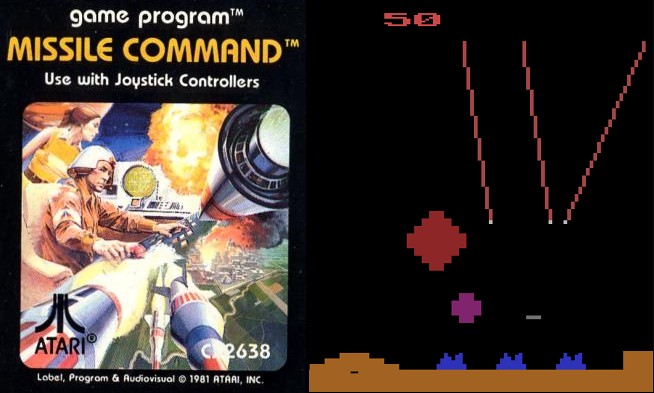
You see only a basic semblance of this in-game, but its intent was to call into being a world richer than what was represented. Creators of such games and their related artifacts were in effect building a bridge, from their own creative intent to that of their players – or, if you don’t believe in “player creativity”, at least their willingness to engage creatively.
Of course, today technological oneupsmanship drives most of big budget game development towards ever-higher fidelity audiovisuals, in part because that’s the easiest way to show off the power of new hardware. The aesthetics of many modern games have in turn adapted to embrace this – as Epic’s lead designer Cliff Bleszinski recently pointed out, there are lots of bald space marines with intricate, scuffed metal armor in games today because current graphics hardware is really good at that. Are we really okay with this being the driving force of our medium, though?
Clearly, the limitations that once forced creators to work with low fidelity and wield the power of suggestion have all but slipped away completely. Paradoxically, in many art forms this kind of event is exactly the point at which some artists begin to explore how that limitation can be wielded intentionally, as a fruitful restraint, a challenge to inspiration, a means to broaden the scope of what is thought possible.
Sparse Matrices / the Art of “Not Showing”
To paraphrase some wisdom I’ve heard from horror filmmakers, “the monster in the audiences’ heads is scarier than any monster you can put on screen.”
Numerous technical problems with the animatronic shark during the filming of Jaws forced Steven Spielberg to adopt a cinematographic style that was more about implication, the menace of things offscreen or barely seen, or built up through the soundtrack. It had quite an effect on viewers and revolutionized how films like it were made.
Audio can indeed be a powerful aid to this – it’s spatial, subjective and suggestive where visuals fail to be. The two older games that have best retained their ability to frighten and immerse me are Thief and System Shock 2, and they do it largely because of their masterful audio, and in spite of their primitive graphics.
Whether you’re hiding information to scare people, or paring it away to help someone paint a picture in their own heads, the mechanism is the same.
In mathematics and programming, there’s something called a sparse matrix. Unlike a normal array where every value is filled in with a number, like the 1:1 grid of pixels on the display you’re reading this on, a sparse matrix is only filled in where there’s a non-zero number.
It’s a glancing blow of a metaphor, but I think human imagination and memory work kind of like this. Whatever isn’t filled in becomes breathing room. What we as creators don’t show the player creates a space they can fill themselves and inhabit mentally in the larger context of what we do show.
Allow Players to Imagine
However, if you’re a creator it takes some discipline to choose to not fill something in with marvelous detail, and some craft to know exactly when and when not to apply this principle for effect – as an intentional feat of simplification, rather than an omission.
Now that technology can do so many things for us, the default approach today has become “spell everything out as explicitly as possible”. This is changing, however.
So the original question stands: what games would we make if we embraced this fully?
In the last five to ten years, the idea of games with highly stylized visuals has gone from fringe to wide acceptance. Beyond simply looking beautiful or distinctive, stylized / abstracted art plays on the visual side of our cognition and imagination.
Chapter 2 of Scott McCloud’s “Understanding Comics” describes this as “Amplification Through Simplification” – that by removal of well-chosen details from a representation of something, an artist can clarify it, focus its intent, broaden or twist its meaning.
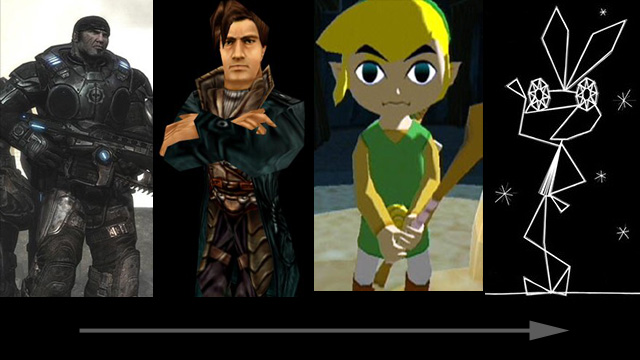
I don’t think this is a purely visual phenomenon, though. In games, we represent the world and its rules to players via interactions. The sense we give players of its possibility space early on, through training and fiction, can create a space players will inhabit with their imagination.
Remember your first hour with Shadow of the Colossus, when you’d only fought maybe one of the beasts? The sparse loneliness of world seems to continue forever. What’s out there? What are you trying to accomplish? What are the limits?
Hours later, you’ve mastered the world and know how it works; you know what to expect. You know what isn’t in the game… earlier possibilities have faded.
However, the mystery of the place stays with you. If players participate imaginatively even for a short time, that ripples outward to enrich the rest of their experience.
That’s another reason I used Ultima IV as an example to start with – the vastness of its world, combined with the simple art and feeling of freedom to explore, create a similar experience despite the radical difference in fidelity.
Other games have a story that stands out much more clearly from their gameplay dynamics. Even in these, there can be vectors that lead us to imagine – stories that are driven by mystery invite us to speculate, to dream up alternate possibilities – who is the G-Man? What happened to Rapture? We invite more of the game into our creative consciousness – we imagine. Even in games with completely traditional linear storytelling models, this is powerful stuff.
Conclusion
In the future I’d like to see more games wield this power intentionally and explore what’s possible with it. I’d like to see designers stylize or not show something by choice rather than, as Ultima IV did, as a technological compromise. I want to make games that people want to invite into their imaginations. If it sounds like I’ve cast a wide net in searching for examples and potential directions, that’s because there are so many avenues… which is very inspiring.
Steve Jobs once claimed that computers are “a bicycle for the mind”. Videogames could be a bicycle for the imagination, if we have the will to broaden our medium in this direction.
[1] I wrote a bit of code to create this animated screenshot. You can download the program here. Instructions are included.
[2] To be clear, even the most imagination-friendly videogame is still rule-bounded in ways that truly freeform, imaginative play – think kids in a schoolyard playing cops and robbers – is not. The value of the former would not be to replace the latter, but to populate what is currently the vast empty gulf between the two.
September 6th, 2009 at 10:04 am
But videogames, like computers before, are currently a product which must show value so they will be purchased. The greatest amount of purchase usually comes from an object with the most perceived value, which means the greatest common denominator – and not to give offense – implies the lowest number or IQ.
I think videogames will become more a bicycle when, like computers, they become easier to manipulate and design. Already this has proven true with some flash and other mini-games, but the current style and focus seems to be on a quick distraction rather than a long term story or involvement. There are exceptions, http://www.kingdomofloathing.com for one, but it seems the majority of people who are interested in “a game” want something light and fluffy like popcorn. Perhaps this is prevalent of most of the entertainment industry – the rise of summer blockbusters for example – and intellectual, imaginative, purely freeform play is not yet grown enough to encompass a large enough niche to support its continued development.
September 8th, 2009 at 11:02 pm
Nice article. I have to say that I’m surprised you didn’t mention Dwarf Fortress, as it seems like a prime example of what you’re talking about.
September 16th, 2009 at 6:50 am
Nethack is an excellent and very popular example of the kind of game where the player has to fill in the graphics with their imagination.
September 20th, 2009 at 10:26 am
Nethack and Dwarf Fortress are definitely fantastic examples. I thought about using either of them instead of Ultima 4 as an example to lead with, but figured their extreme systems-driven nature and open-endedness (while awesome) might distract from the main point I was trying to make.
Interestingly, Scribblenauts came out recently and arguably turns “use your imagination” into a central game mechanic.
September 23rd, 2009 at 11:20 am
Hi JP,
Just found your blog … Good to see you’re still grappling with the weighty aesthetic issues of game design. I think that the trends you describe here will ultimately be revealed as cyclical in nature. Certainly the enormous popularity of relatively primitive online Flash games (e.g. the Yahoo game room) and iPhone App games indicates that there are many folks who would much rather focus on concept than execution. The stated objective of the Nintendo Wii was more or less to appeal to those types of casual gamers as well: most of us don’t have the time to sit and play immersive role-playing games for hours and hours, but we might have time to do a quick round of Wii boxing or a Yahoo crossword puzzle.
Speaking as someone outside of your industry, I would suggest that your challenge is not only to create environments that encourage players to “engage creatively,” but to create environments that allow players to do so with a limited investment of time. The moment I realized I was no longer a computer gamer was probably 8 years ago, when I tried out a demo of Mario 3-D in a Blockbuster store. Although I had played Mario Brothers games throughout high school, I couldn’t even figure out how to make Mario jump, or even walk in a straight line. Games since then have been so focused on challenging the “hard-core gamer” with experiences that are increasingly complex and time-intensive (perhaps unintentionally confusing, as did my elementary school teachers, the genuinely “challenging” with the merely difficult) that the rest of us simply gave up on games.
March 2nd, 2010 at 10:29 am
Great article! I’m thinking along the same lines for a while now. If you want games to be a medium that individuals can not only consume but also express themselves in you have to stop striving towards high-fidelity.(I explored that in more detail on my own pathetic blog http://pixelpracht.wordpress.com/2009/11/25/retro-2-0/)
What you ask for (and I agree one should ask for!) has parallels to the impressionistic art movement in the 19th-century where artists broke with the rules of traditional paintings and instead of trying to recreate the details of the scene in their pictures they focused on capturing the mood, the essence of the scene. Expressionism pushed this further. Artist tried to express subjective ideas, feelings. When paintings were allowed to do more than picturing physical reality the whole medium become much richer. We need some movement like that with videogames!
To quote a part from Tolkiens essay “On Fairy Stories” :
“To make a Secondary World inside which the green sun will be credible […] will probably require labour and thought, and will certainly demand a
special skill, a kind of elvish craft. Few attempt such difficult tasks. But when they are attempted and in any degree accomplished then we have a rare achievement of Art: indeed narrative art, story-making in its primary and most potent mode.
In human art Fantasy is a thing best left to words, to true literature. In painting, for instance, the visible presentation of the fantastic image is technically too easy; the hand tends to outrun the mind, even to overthrow it. Silliness or morbidity are frequent results.”
I think this captures a problem many modern video games have. They are to visual, too explicit, too photorealistic to leave any room for the players immagination. In Tolkien’s time there were no video games and I refuse to accept his conclusion that literature is the best medium to create a secondary world that has “the inner consistency of reality”. Video games with their interactivity have so much potential to involve the player into something. Make him not only experience but take part in a “secondary world”…
Now I got carried away a little. What I wanted to say: The players imagination is the key! And we have yet to learn to adress it properly in the video games.
April 11th, 2010 at 10:47 pm
A friend of mines passed this blog post to me. I have a lot of feelings why I no longer play video games and in general think the general trends we are working towards are horrible. I am going to use a few games as examples but interpretation of the problem can be applied to any game really. I am going to talk about FPS games because I enjoyed some of them a lot. Thief I thought was pretty good but I never got into it enough.
NS
One of my favorite games ever was Natural Selection, a modification for Half-Life. I know what you are thinking “multiplayer, there is no story or anything!” Yes well that may be but the amount of imagination that could be applied was amazing. When the game first out I admit it had a few quirks that needed to be fixed but in general the initial game had it all. In fact it had more than the developers bargained for…
I remember my first time playing… everyone one at the LAN party was well extremely confused. However we gained an idea of how to play and eventually got the idea down. We created a small guild of friends. At the next LAN party things got nuts. Let me tell you how the game works so I can explain how bananas things became. First there are the Marines who have a commander with an RTS view that gives waypoints, and puts down structures to be built by the other Marines. Their goal is to kill the aliens. The aliens have hives; they start with one and gain new attributes and evolution of different aliens with each hive. Essentially the aliens are trying to get multiple hives and require at least two to stand a chance at the Marines who are just trying to get resources from the nodes (that both sides want to control to spend the resources on abilities/weapons/structures) to upgrade and lay down areas of turrets before the aliens get powerful with a second (still stand a chance) or a third hive (probably screwed Marines at this time).
Well the other features this game has or had was complicated rooms, tons of vents that were sometimes sealable or openable via a welder tool Marines could get – these vents systems some times had rooms in them of varying sizes – doors, elevators, you name it with lots of shadows. When we started out our second time together as an alien builder (Gorge) I knew the defense structures (about the size of 4 Marines back to back) could spit acid at Marines and defend our hive as we were elsewhere procuring another hive. Then I discovered you could STACK THEM ON TOP OF EACHOTHER. That quickly led to barriers of them that the Marines would not go near. I had one set at the vent to our hive, and another at the only other real entrance not guarded by my comrades which was at the end of a hallway that had a huge elevator that the Marines came down. They tried grenade launcher but got no wear to my massive allotment of defense structures. Then awhile after I died, confused and all of my structures died off as well and they soon arrived at our single hive and wiped us out. We held them and all there technology with nothing more than first hive abilities and evolutions for who knows how long, it was war. Well what ended it was the discovery of siege cannons which fire through walls and only hit building and aliens in the immediate area. They hit hard too.
After that discovery it became regular practice to hit hives with them. As players got better it became increasingly hard to get the siege cannons in range or hives which now usually had the array of defense structures as to guard them instead of having to prevent sieging in multiple places. The devs later nerfed the siege cannons so that a marine had to spot the structure they would shoot and that was fine. I have no idea how many games I played where the aliens strategically build things, often in vents (which builder aliens had to be boosted into by other players) to prevent the Marines from having the chance to spot hives at all. However the Marines quickly adapted and started building arrays of turrets and siege cannons inside of the events. That caused a lot of stir in the aliens because they had no idea where the damn thing was hitting their hive from. Yes the maps had that much area to explore. The Marines even came to a point where they would move their base, and in last ditch circumstances would move one into a vent system. The bases had the command chair (RTS view entry), spawners, ammo station, etc…
The aliens were ever pesky, hiding in shadows, deep corners, you name it. They even had mild cloak ability. They had to though because the early stages of evolution had power but died quickly. They were fast and small in a vast map… it was a blast. The inventiveness that followed by building things in strange locations was great. Then jetpacks hive rushes were discovered… of course a good alien team would just shoot webs to kill the jetpackers and then it was all over. This however gave an element that required a time sensitivity to be accounted for… “we must do this before they do that and get this or we are screwed on this map.” Dynamic… fun… evolving game strategy…
Then the new patches came out that started following the new trends that ruin things. First off no one ever fully exhausted the potentials in the original game before it got serious changes. They instead let all the people who were awful at the game and got spanked by people that actually played with intent direct where it went. I stopped playing.
What did they do? Now you can not see where you are going because the maps are fat, blump, and lack that deep big awness that earlier games had like the first Aliens vs. Predator might be another example (where as Alien vs. Predator 2 was bubbly and lacked darkness, not scary at all). Your screen is covered in way points and dots and stuff anyways, like you are no longer required to know your way around! There is no explorering! There are no strange doors and switches for them or big vent systems. It is all straight forward run and shoot or bite. It is nothing but see who clicks fastest. Further more there is no where left hide in the small maps. I remember being a Marine and walking down a super ordinary hallway was dangerous because of the 1 ft bracing that was in an octagon shape was enough room for an alien to hide, or under the grate at your feet; YOU HAD TO LOOK EVERYWHERE EVERY STEP, it was scary especially when devious minds of humans wielded those ankle biters. All of that is gone and filled with motion tracking or some other crap that lets you know where things are. Most of the characters can not jump onto tiny ledges of moldings in the rooms or climb up weird places that exist for no apparent reason but to look cool and have dark shadows.
Almost all FPS multiplayer games are like this now…
There is nothing to explore in the maps… sure sure everyone eventually figures it all out but the fact that they were complicated with lots of unnecessary places a character to be increased the overall possibilities and there for stimulated and used peoples imaginations to respond to the ridiculous things people did like hiding on the other side of doors standing on a red emergency light or something impossible in real life.
Next they all have those disgusting mini-maps. I hate them I hate them I hate them. No one has to know maps and you never have to keep track of your teammates if FF is on. Plus if an enemy shows up at all on anyone’s screen everyone without the point of view knows where they are because one person can see them. What is this crap? I remember playing counter strike and being scared out of my wits with nothing more than a small tab screen that told me how many other people where still alive out there trying to kill just me who is left over… I had to sneak around and be really quiet. I had to play mind games with them making them think I was different places, and surprise them from unlikely places to be hiding. I had to use my imagination to combat them in a world of uncertainty and yet it was all a gamble because who knows what they were doing? This could have been as simple as just ducking midway between two common fortified positions and waiting for them to point their crosshairs at either one of them when I know where they are and pop them. Now if they see me once I can not even run away to be quiet again because in most games there are no possibilities for places to run jump and hide too, you just appear on their mini-map for the next thirty seconds. This leads me into my next complaint with limiting your imagination greatly… The realism thing…
I played video games because it was not real life, because the amazing, absurd, and sciencfictiony stuff was going on!
Today’s games are solely based on realism typically even if they are in the future. What does that mean for killing imagination? Well maybe I like carrying around 10 huge guns with crates of ammo. If I go target practice I have to reload all the time but I have to put the bullets in the magazines and it all takes forever but the results are real… the sound barrier breaks and thing are violently altered at the other end. In a game you get the idea of that but it is no where near the same so why suffer the long lead in for a result that is not magnificent? In real life if I run too long I get tired but I also eat, nap, and get the benefit of being better at running later which is personal and part of me not just computer software. Why do I want some character in a game to be hampering my creative ideas for killing the bad dudes by being out of breath every 50ft?
They are killing the part of a “game” with realism. I can go do all the painstaking things for real rewards, in real life. One of my favorite game series, Max Payne, does not have these boundaries. What does it have? Well I can run jump and tumble endlessly all in “bullet time” which is slow motion but I move a little faster than the enemy with my mouse look. That allowed me to be a craftsman, an artist, at killing the enemy. I could walk into a room and lay every punk ass mother fucker down in a couple of seconds if I planned my diving, turning, rolling, and reloading correctly. Is that not what made the Matrix cool, or Equilibrium? Oh and who the hell wants to spend the majority of the time playing video games waiting for their out of shape badass character to catch his breath? Boring, snooze. Next up is the fact that this situation also dulls capability. I feel like most of the FPS games these days are like playing KOTOR. You can only walk where they want, and even if you do not have to the likelihood of you jumping on top of anything by standing on a 3 inch wide fence are pretty slim since you are winded after your 12 inch vertical jump has been used more than twice. What is interesting about purely linear combat due to the approaches being strictly as intended? I will admit I liked some games that had some of this but they had so many other things going on. The original Call of Duty was one of them because of the dynamics where super fun. The way you played every map was often vastly different from the approach of the one before.
Really is linear capability that leaves you with one way to approach enemies that fun, is having to spend all your time aiming through iron sights, catching your breath, or looking at the mini-map really progress in games? I think it is post-modern bullshit.
What I want?
I want games with more possibilities than the devs intended on, for the community to develop the game play in it (ok I like multiplayer games a lot, or did). I want it to feel like a video game so that I run around fast, act fast, but have to explore. I am sick of how slow games are. Why are they slow? They are slow so every one in the world that wants to play can play without feeling entirely lost. That is post-modern bullshit that caters to the lazy that ask not to think. People that play to get better should be better and should not be limited to reaction speed. Brain and wits should count but they mean nothing with a mini-map and voice communication. They have to stop nerfing everything. They need to use realism elements when it BENFITS THE GAME, NOT BECAUSE YOU CAN.
I want stories in the game that develop with my game play. I get tired in modern games spending my time LOOKING FOR THE STORY. OH MY GOD BORING. Max Payne I loved, it had a comic book built into it with fantastic voices reading it to you. It was dark, had been drawn by someone, voiced by someone, and it could give you feelings on things that were all new that the 3d world could not offer… The story also changed with difficulty settings… That was rad.
Scare me. Stop trying to show off graphics so much that you sacrifice the game. If the part of the game is best suited to have low visibility so be it… That made the first Aliens vs. Predator – as a marine primarily – so scary that my friends would not play it in the middle of the day let alone at night! It was scary because things happened lightening fast and visibility was extremely small a lot of the time. It felt like the movie, it scared the shit out of you and by that I mean you wanted to go poop because the release felt good after having your nerves racked from aliens jumping at you traveling 50mph that were not even visible until 15ft from you even with night vision… Use twisted ideas and thoughts, run deep with psychological trauma accompanied by exceptional musical tracks that fit the mood.
Visually appease me not over stimulate me. Yes I like how Mass Effects 2 looks but every 5 ft you are behind a box and everything you look at just looks like blurry art so the affect is loss through repetition. When I think visually appealing, put me in awe by being able to look up at a grand tower the citadel in Half Life 2. Make me feel small, impotent in a world too big for me to deal with even if I can not explore it all but not endless fields of nothing like in Far Cry 2 the most boring game ever. How about a little vertical exploration? I have seen less and less of that lately. Save a little bit of awe for the big monster boss. If every enemy I cross I have time to examine and it blows my mind how am I going to be blown away by the big dude at the end of the level? What if he is realistic and boring? Why not give him some personality and bizarre ass unrealistic qualities that no one can explain?
I would like to play a game where I can explore in ways unknown, interact in strange ways, be confused and alone even in multiplayer. I would like to interact with strange unrealistic creatures; give me a world that looks like early Walt Disney and Alejandro Jodorwsky threw up all over.
RTS and RPGs?
I liked it back when I could name my own things, and make them! I liked ridiculous over the top astounding figures that were hard to comprehend. I liked mystery, I liked shadowy figures (often called only that), and I liked no intended way to play just respond to the enemy combating against you. Where are the riddles? Where is the continuous play for enjoyment and not just skill? I play single player games to appreciate the surroundings, enemies, and new ways to combat challenges (that goes for all games). All I have seen lately is them waxing their noodle (ego-techno-jerk-off) so I can feel like I am waxing my noodle because I can tell how realistic this game “I own” happens to be.
I got a lot of thoughts but they are disappearing the more I think about how all the new games think for me, but make me work real hard by taking up all my freaking time trying to do its pre-ordained game play just to get to the boring sub-Sci-Fi channel story.